
Fremont County Criminal Court Cases
Fremont County belongs to Iowa Judicial District 4. Iowa uses one unified District Court, not separate county felony, misdemeanor, and municipal criminal courts. District judges hear felony matters. Associate district judges and magistrates handle assigned misdemeanors, traffic cases, preliminary work, and initial appearances. A city arrest in Sidney, Tabor, or Shenandoah therefore does not create a city municipal-court prosecution. The filed state case belongs in District Court, although a Shenandoah event may require checking whether the case was filed in Fremont or Page County.
The Fremont Clerk of District Court is the legal custodian of local criminal case files. The clerk's first-floor counter is at 506 Filmore Street, P.O. Box 549, Sidney, IA 51652. Call 712-374-2232 for record and copy questions. Case scheduling uses 712-328-5754. The County Attorney prosecutes cases but does not replace the clerk as the copy or certification office.
Fremont County Court Case Prefixes
A case number often shows the right local route before a reader opens the docket. The Fremont County Attorney identifies FECR, AGCR, and SRCR as criminal case prefixes used for felony, aggravated-misdemeanor, and serious-misdemeanor matters. SMMG marks simple misdemeanors, while STA and NTA are traffic-related prefixes. These labels help sort results, but the charge and disposition fields still control what happened.
- FECR
- A Fremont County felony criminal file in Iowa District Court.
- AGCR
- A Fremont aggravated-misdemeanor criminal case.
- SRCR
- A Fremont serious-misdemeanor criminal case.
- SMMG
- A Fremont simple-misdemeanor case handled within the unified court.
- STA or NTA
- Traffic-related files with separate Fremont contact instructions.
Note: A Fremont case prefix classifies the file; it does not establish the final charge, plea, judgment, or sentence.
Searching Fremont County Case Records
The free Iowa Courts Online Search is the main remote index. A complete case number gives the cleanest match. When only a name is known, select Fremont County and the relevant criminal or traffic case type, then compare dates and public case context. A name match alone does not prove identity. Desktop access can work better because the portal uses framed pages.
- Open Trial Court Case Search for the Fremont filing rather than the appellate path.
- Enter the full Fremont case number, or search the name when the number is unknown.
- Choose Fremont in the county control and narrow the case type or date range.
- Open the matching Fremont docket and read the charge sequence through disposition and sentence.
- Contact the Fremont County clerk for a filed document, plain copy, certified copy, or archived record.
| Field Label | Type | Required | Use |
|---|---|---|---|
| Court level | Tab or path | Yes | Select trial court for Fremont criminal filings. |
| Case number | Text | No | Best when the complete Fremont prefix and number are known. |
| Name | Text fields | No | Spelling and common names can produce false Fremont matches. |
| County | Dropdown | Recommended | Select Fremont to isolate local District Court cases. |
| Case type | Filter | No | Narrow Fremont results to criminal or traffic categories. |
| Date range | Date fields | No | Useful with a common name or known Fremont filing period. |
Once a likely Fremont County case appears, record the case number before leaving the screen. Follow every docket event through judgment rather than stopping at the first charge. If the same name produces several results, compare the filing period, county, case prefix, and public event history. Do not use a protected identifier to publish or confirm identity. For a document that is not shown online, give the clerk the case number, document title or docket date, and desired copy type. That detail lets the records counter answer a focused request without guessing which file or filing is meant.
Fremont County Dockets Versus Documents
The free Fremont docket is an index, not a full document library. It can lead to Fremont parties, charges, events, hearings, judgment, financial entries, and sentence data as clerks enter them. Yet many Fremont pleadings and orders still require the courthouse public-access terminal or a clerk request. Advanced Iowa Courts Online access costs $25 per month and adds broader party, judgment, exhibit, financial, service, scheduling, traffic, and case-type search options. It still does not include Fremont document images.
The Iowa Judicial Branch payment page shows how Fremont case search and payment functions connect.

That screen is useful for payment status, but it is not a substitute for reading the full Fremont County criminal docket and judgment.
Inside a Fremont County Case File
A Fremont County court file centers on the case number and chronological docket. The original complaint or trial information states filed allegations. Later entries may show amended counts, motions, appearances, plea proceedings, trial events, judgment, sentence, fines, costs, restitution, warrants, or satisfaction. Because the prosecutor may file a different charge from the jail's intake entry, the final docket should be read from start to finish.
| Case number and court | Identifies the Fremont filing, prefix, case type, and District Court venue. |
|---|---|
| Charging document | States the formal allegations selected for Fremont prosecution. |
| Docket entries | Lists Fremont filings, hearings, motions, service, warrants, and court action by date. |
| Parties and roles | May identify counsel, judicial officer, and public roles in the Fremont case. |
| Disposition and judgment | Shows dismissal, acquittal, plea, conviction, or another resolved Fremont status. |
| Sentence and financials | May show Fremont confinement, probation, fines, costs, restitution, and payments. |
Protected identifiers and confidential Fremont filings are not part of ordinary public display. Ask the Fremont clerk which public version can be inspected or copied.
Fremont County Court Forms and Copies
Use the Iowa Judicial Branch court forms library when a formal court filing is required. The library includes criminal and expungement-related forms, but a form does not answer whether a specific Fremont County case qualifies for relief. The docket, final disposition, court debt, and controlling Iowa statute must be checked first.
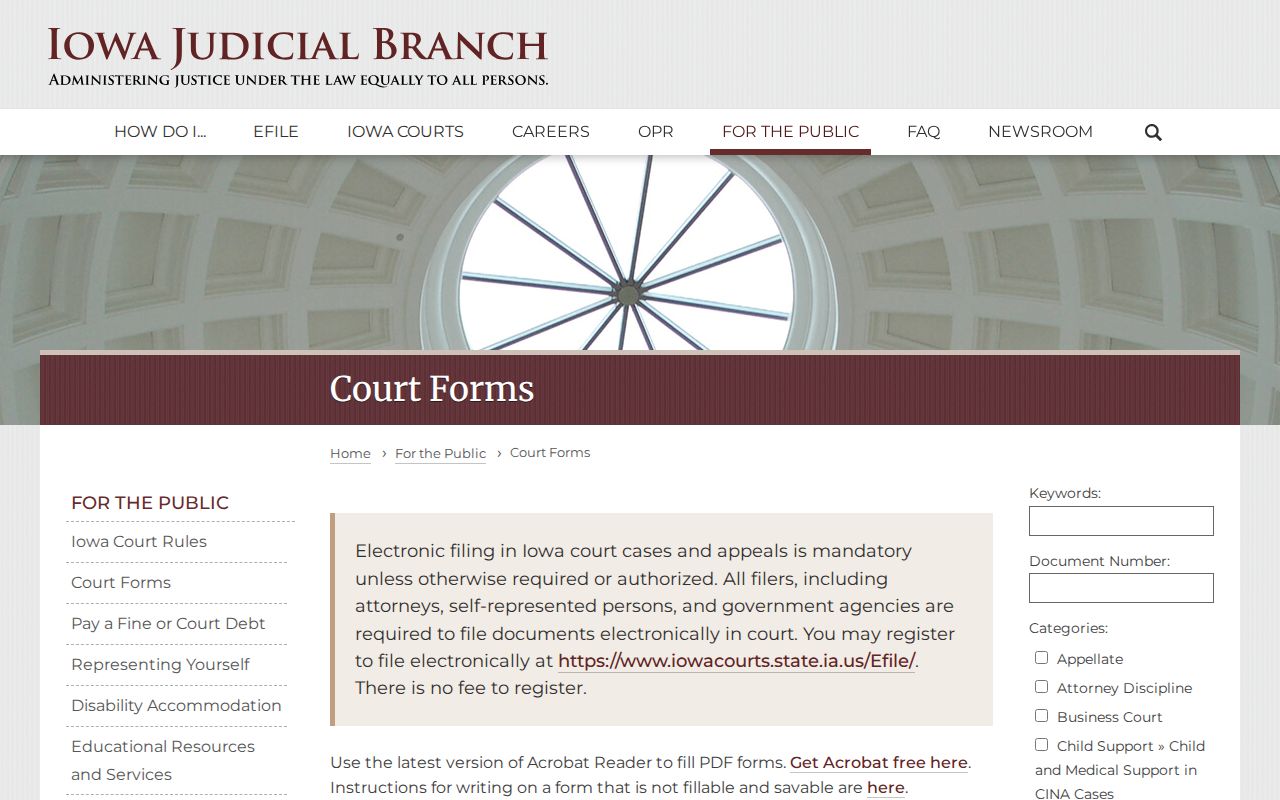
The official forms page supplies statewide documents, while the Fremont clerk handles local filing, public copies, certification, and archived-file questions. Ask for a cost estimate before ordering. Older paper or scanned material may not appear in the online index, and the clerk can explain whether it remains at the courthouse or is stored elsewhere.
How a Criminal Case Moves
The Fremont court file begins only after a complaint, trial information, or other charging paper is filed. A Fremont arrest may come first, but not every arrest becomes a case. At arraignment, the charge and plea are addressed. Pretrial entries can record discovery, motions, scheduling, bond review, and negotiations. A plea or trial then leads toward disposition. If there is a conviction, the Fremont court records judgment and sentence. Appeals or later motions can add more entries.
Fremont County case flow: Charges Filed › Arraignment › Pretrial › Plea or Trial › Disposition › Sentencing
The Fremont County Attorney publishes Monday criminal-session instructions for SRCR, AGCR, and FECR matters. Fremont simple-misdemeanor and traffic contacts use a separate Tuesday and Thursday window. A posted session route helps interpret a Fremont docket, but the official hearing notice and current court calendar control.
Fremont County Charges and Judgments
A Fremont booking charge records the allegation at jail intake. A filed Fremont charge records the prosecutor's decision. The judgment records what the Fremont court ultimately decided. Those entries can differ because a count may be amended, dismissed, replaced, or resolved through a plea. Reading only the first charge can leave the outcome wrong.
For a recent event, compare the official Fremont County arrest lookup routes with the criminal court case. The sheriff or jail can confirm the arrest and custody layer. The clerk's docket supplies the filed charge and result. Iowa DCI supplies a separate statewide repository product under its own release rules.
The Iowa Division of Criminal Investigation explains the state repository's role after a Fremont case.
That repository view adds statewide criminal-history context, but it does not replace the filed Fremont County pleadings, motions, judgment, or certified court copy.
Fremont County Criminal Clerk Counter
When the portal stops at an index entry, contact the Fremont Clerk of District Court. Give the full case number when possible, identify the exact document or date range, say whether a plain or certified copy is needed, and ask for the current fee before authorizing work. For an old file, ask whether it is archived, scanned, or stored outside the courthouse.
Fremont Clerk of District Court
506 Filmore Street
P.O. Box 549
Sidney, IA 51652
712-374-2232
Fax: 712-374-3330
CountyClerk.Fremont@iowacourts.gov
Use 712-328-5754 for case scheduling. Court administration can route accommodation questions, but the clerk remains the first contact for a public Fremont County criminal case record.
Case Record Access & Restrictions
Iowa's Open Records Law supports inspection and copying of Fremont public records, while Iowa court rules and other statutes protect specific material. Most Fremont juvenile records are confidential. Victim-sensitive facts, medical data, personal identifiers, sealed material, and some investigative filings can be withheld or redacted. An online omission may reflect a restriction, a legacy Fremont file, or a clerk-entry issue rather than proof that no case exists.
If a Fremont County criminal case cannot be found, check spelling, county, case type, prefix, and date range. Then ask the clerk whether the record is archived or restricted and what procedure applies. A request for a redacted public portion may succeed when the full filing cannot be released. Expungement and confidential treatment are statute-specific; they do not mean every justice agency destroys every related record.
Note: A filed Fremont charge remains an allegation unless the docket records a conviction or other final finding.